
Flat Interest Rate vs Reducing Interest Rate Calculator Online
Use our Flat Rate vs Reducing Rate Calculator to compare flat interest rates, calculate the equivalent reducing rate, EMI, and total loan interest.
Free & easy to use • Instant calculations • No signup required • Indicative results
Is a Flat Rate the Same as a Reducing Rate?
No. A flat interest rate is not the same as a reducing interest rate. A flat rate calculates interest on the original loan amount throughout the tenure, while a reducing rate calculates interest on the outstanding loan balance as you repay the principal.
Therefore, the same quoted interest rate can result in a different EMI and total interest cost. Use our Flat Rate vs Reducing Rate Calculator to compare the two methods and find the equivalent reducing-rate cost.
A 14% flat interest rate is not equivalent to a 14% reducing interest rate. The equivalent reducing rate depends on factors such as the loan amount and tenure.

Flat vs Reducing Rate Calculator
See what your “low” flat interest rate actually costs — in real reducing-rate terms
If this were charged as a Reducing Rate instead (same % quoted):
⚠️ This is an indicative estimate. Actual loan agreements may include processing fees or other charges not captured here — always check your lender’s amortization schedule.
Flat Rate vs Reducing Rate — What’s the Difference?
Flat rate: interest is calculated on the original loan amount for the entire tenure — even in the last month, when you’ve already repaid most of the principal, you’re still charged interest as if you owed the full amount.
Reducing (diminishing) rate: interest is calculated only on the outstanding balance. As you repay principal, the interest charged shrinks along with it — this is how home loans and most bank loans work, and it’s the fairer, lower-cost method.
Because of this difference, a flat rate always costs more than a reducing rate at the same quoted percentage — which is exactly why lenders who use flat rates often quote a lower-sounding number.

What Is a Flat Interest Rate?
A flat interest rate is a method of calculating loan interest where interest is charged on the original loan amount for the entire loan tenure, even as the borrower repays the principal through monthly EMIs. Because the interest is based on the initial principal rather than the outstanding balance, the actual cost of a flat-rate loan can be higher than the quoted rate may suggest.
How Does a Flat Interest Rate Work?
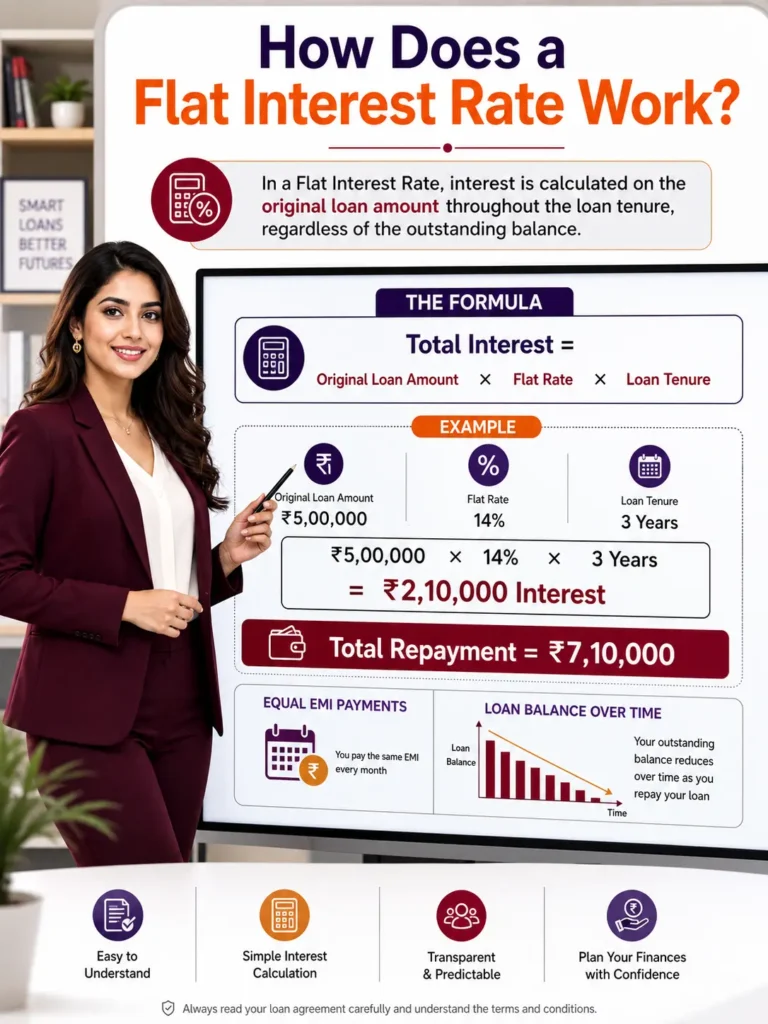
Under the flat-rate method, interest is calculated on the original loan amount for the entire tenure. The total interest is then added to the principal and divided across the repayment period to determine the EMI.
Flat Interest Formula:
Total Interest = Original Loan Amount × Flat Rate × Loan Tenure
For example, for a ₹5,00,000 loan at 14% flat interest for 3 years:
- Total interest = ₹2,10,000
- Total repayment = ₹7,10,000
- Approximate EMI = ₹19,722
The key difference is that the interest is based on the original principal, not the declining outstanding balance. Therefore, a 14% flat rate is not equivalent to a 14% reducing rate.
This is why a flat interest rate should not be directly compared with the same percentage reducing interest rate. Use the Flat Rate vs Reducing Rate Calculator to estimate the equivalent reducing rate and compare the total interest cost.

What Is a Reducing Interest Rate?
A reducing interest rate calculates interest on the outstanding loan balance, rather than the original loan amount. As you repay the principal through each EMI, the outstanding balance decreases, so the interest charged also reduces.
Reducing Interest Formula:
Monthly Interest = Outstanding Principal × Annual Interest Rate ÷ 12
For example, if you take a ₹5,00,000 loan at 14% reducing interest, interest is initially calculated on ₹5,00,000. After each EMI reduces the principal, the next month’s interest is calculated on the lower outstanding balance.
This method is also known as a reducing balance or diminishing balance method and is commonly used for loans where interest is calculated on the outstanding principal.

How to Convert Flat Rate to Reducing Rate
A flat interest rate cannot be converted to a reducing interest rate using a simple percentage formula because flat-rate and reducing-rate loans calculate interest on different principal balances. The equivalent reducing rate depends on the loan amount, flat rate, tenure, EMI, and repayment method.
How Is the Equivalent Reducing Rate Calculated?
The flat-rate EMI is first calculated using the original loan amount and total flat-rate interest. The calculator then finds the reducing interest rate that produces the same EMI on a declining loan balance.
In simple terms:
Flat Rate → Calculate Flat EMI → Match EMI with Reducing Rate → Find Equivalent Reducing Rate
Use our Flat Rate vs Reducing Rate Calculator to calculate the equivalent reducing rate, compare EMI, and understand the difference in total loan interest cost.
How Is Flat Rate EMI Calculated?
A flat rate EMI is calculated by adding the total flat-rate interest to the original loan amount and dividing the total repayment by the number of monthly instalments.
Flat Rate EMI Formula:
EMI = (Loan Amount + Total Flat Interest) ÷ Number of Months
For example, on a ₹5,00,000 loan at 14% flat interest for 3 years, the total interest is ₹2,10,000 and total repayment is ₹7,10,000.
Therefore:
EMI = ₹7,10,000 ÷ 36 = ₹19,722 per month
This flat-rate EMI calculation differs from a reducing-balance EMI because reducing-rate interest is calculated on the outstanding principal after each repayment.

How Is Reducing Interest EMI Calculated?
A reducing-rate EMI is calculated using the loan amount, reducing interest rate, and loan tenure. Unlike a flat-rate EMI, interest is calculated on the outstanding principal, which decreases after each EMI payment.
Reducing Rate EMI Formula:
EMI = P × r × (1 + r)ⁿ ÷ [(1 + r)ⁿ − 1]
Where:
- P = Loan amount
- r = Monthly interest rate
- n = Total number of monthly instalments
For example, for a ₹5,00,000 loan at 14% reducing interest for 3 years, the EMI is approximately ₹17,089 per month. As the outstanding principal decreases, the interest component of each EMI also reduces.
Flat Rate vs Effective Interest Rate
The flat interest rate quoted by a lender does not represent the same borrowing cost as the effective interest rate on a reducing-balance loan. A flat rate is calculated on the original principal, while an effective rate reflects the interest cost based on the outstanding loan balance.
For this reason, a 14% flat interest rate can have a much higher effective cost than 14% reducing interest. When comparing loans, look beyond the quoted rate and consider the EMI, total interest, fees, and overall repayment cost.
Flat Rate vs Reducing Rate Calculator FAQs

Explore More Loan & Finance Calculators
Planning a loan involves more than comparing interest rates. Your borrowing decision can also depend on the monthly EMI, total interest, loan affordability, repayment tenure, and potential prepayment savings.
Explore our collection of free loan and finance calculators to estimate EMI, compare borrowing costs, check loan affordability, calculate interest savings, and plan your repayments using your own loan details. Whether you’re considering a home loan, personal loan, car loan, education loan, or other financing, these tools can help you understand your borrowing costs before making a decision.
Use our calculators to calculate EMI, compare loan costs, check loan eligibility, estimate prepayment savings, and plan your repayment strategy with greater clarity.
- Personal Loan EMI Calculator – Monthly EMI Calculator
- Car Loan EMI Calculator – Monthly EMI & Interest Calculator
- Home Loan EMI Calculator – Monthly EMI & Interest Calculator
- Education Loan EMI Calculator – Know EMI Before Course Completion
- Free Business Loan EMI Calculator For MSMEs & Startups
- Loan Against Property EMI Calculator – Calculate LAP EMI Online
- Free Term Loan EMI Calculator – EMI, Interest & Amortization
- Free Loan Balance Transfer Calculator: Calculate EMI Savings
- Bike Loan EMI Calculator – Find The EMI That Fits Your Budget
- Gold Loan EMI Calculator – Calculate EMI & Interest Online
- Commercial Vehicle Loan EMI Calculator With EMI Breakdown
- Term Loan Prepayment Calculator – Calculate Interest Savings
- Loan Part Payment Calculator – Save Interest & Reduce EMI
- Home Loan Eligibility Calculator – Check Maximum Loan Eligibility
- Personal Loan Eligibility Calculator – Check Loan Eligibility
- Home Loan Affordability Calculator – Estimate Home Buying Budget
- Loan Tenure Calculator – Calculate Loan Duration From EMI
- Compare Loan Offers Online | Free Loan Comparison Calculator
- Loan Interest Rate Calculator (EMI To Interest Rate) – Free Online
- Loan Amount Calculator – Calculate Maximum Loan Amount From EMI
- Debt-to-Income Ratio Calculator – Check Loan Eligibility
- Rent Vs Buy Calculator Online – Compare EMI, Rent & Investment
- Fixed Vs Floating Interest Rate Calculator – Compare EMI & Interest

Get More Finance & Calculator Tips
Get useful loan, EMI, finance and money-saving tips delivered to your inbox. Subscribe for new calculators, practical insights and helpful updates.
Disclaimer
The Flat Rate vs Reducing Rate Calculator is provided for informational and educational purposes only. Results are indicative estimates based on the loan amount, flat interest rate, tenure, and assumptions entered by the user. Actual EMI, interest charges, repayment amounts, fees, and loan costs may vary depending on the lender, loan agreement, repayment schedule, and other applicable charges. ToolSuite does not guarantee the accuracy of lender-specific calculations or any particular financial outcome. This calculator should not be considered financial, investment, lending, credit, or professional advice. Always verify the actual interest calculation and repayment schedule with your lender before making a borrowing decision.