
Personal Loan Eligibility Calculator – Know How Much You Can Borrow Instantly
Estimate your personal loan eligibility based on your monthly income, existing EMIs, FOIR, interest rate, and loan tenure. Get an instant estimate of your eligible loan amount and affordable EMI—free, accurate, and no signup required.
Free Calculator • ✓ Instant Results • ✓ Works for Salaried & Self-Employed Users
What Is a Personal Loan Eligibility Calculator?
A Personal Loan Eligibility Calculator is a free online tool that estimates how much personal loan you may qualify for based on your monthly income, existing EMIs, employment type, loan tenure, interest rate, and FOIR (Fixed Obligation to Income Ratio). It helps you understand your borrowing capacity before applying for a loan, making it easier to compare lenders, plan your EMI, and improve your chances of loan approval—without affecting your credit score.

Personal Loan Eligibility Calculator
Find out how much personal loan you can get based on your income
⚠️ This is an indicative estimate only, not a loan offer or guarantee. Actual eligibility is determined by the lender based on credit score, verification, and policy.
How is Personal Loan Eligibility Calculated?
Personal loans are unsecured, so lenders apply a stricter FOIR (Fixed Obligation to Income Ratio) than secured loans like home loans — typically 30–60% depending on your income and credit profile.
Formula used: Max EMI = (Total Monthly Income × FOIR%) − Existing EMIs, then Loan Amount is derived using the reducing balance method. Tenure is capped at 7 years (standard personal loan policy) and further limited by your age relative to retirement (60 for salaried, 65 for self-employed).
Actual eligibility varies by lender and also depends on credit score, age, employment stability, and existing relationship with the bank — use this as an estimate, not a final offer.
🚀 Ways to Increase Your Eligibility
- Add a co-applicant or guarantor — a second income source can boost the total loan amount you qualify for.
- Pay down existing EMIs first — since personal loans use a stricter FOIR, clearing smaller debts first has an outsized impact.
- Improve your credit score — a score above 750 is often the difference between a 12% and an 18% interest rate offer.
- Use your salary-account bank — lenders where you already hold an account often offer better FOIR limits and faster approval.
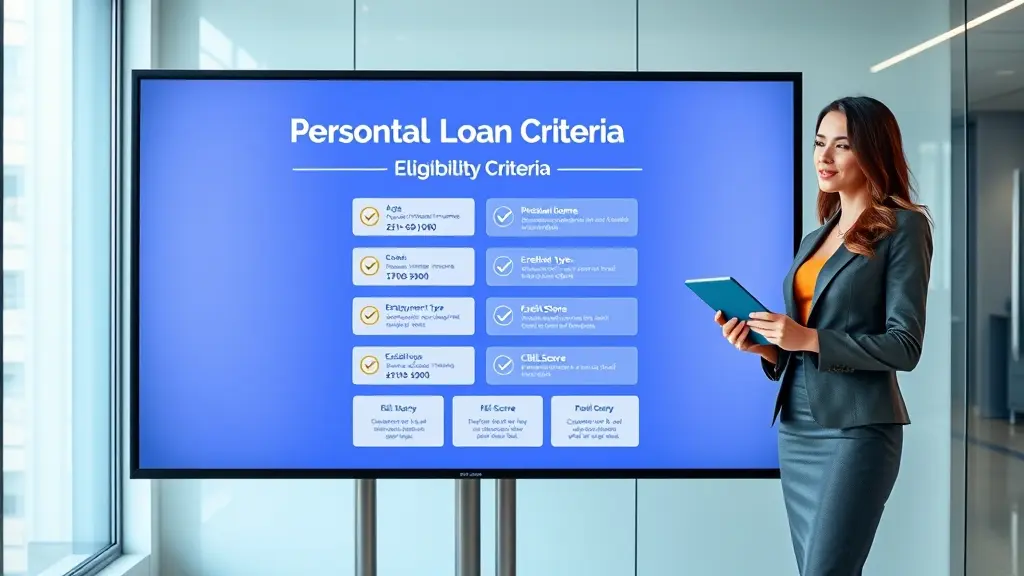
Personal Loan Eligibility Criteria in India
Banks and NBFCs assess your monthly income, existing EMIs, credit score, employment stability, age, and FOIR (Fixed Obligation to Income Ratio) before approving a personal loan. Understanding these eligibility criteria helps you estimate your borrowing capacity and improve your chances of loan approval.
Age Criteria
Applicants are generally required to be between 21 and 60 years if salaried and up to 65 years if self-employed, subject to lender policy.
Minimum Monthly Income
Most lenders prefer a minimum monthly income of ₹20,000–₹30,000. Higher income usually increases your eligible loan amount.
Credit Score
A CIBIL score of 750 or above is generally considered favourable and may help you obtain better loan limits and lower interest rates.
Employment Stability
Both salaried employees and self-employed professionals can apply, provided they have stable and verifiable income.
Existing EMIs & FOIR
Most lenders keep the FOIR between 30% and 60%. Lower existing EMIs improve your personal loan eligibility.
Documents Required
Typically includes PAN, Aadhaar, address proof, salary slips or income proof, bank statements, and recent photographs.

Factors Affecting Personal Loan Eligibility
Your personal loan eligibility is determined by several financial and personal factors that help banks and NBFCs assess your repayment capacity. While every lender follows its own credit policy, the following factors have the greatest impact on the loan amount you may qualify for. Understanding these factors can help you improve your borrowing capacity before submitting a loan application.
1. Monthly Income
A higher and stable monthly income generally increases your personal loan eligibility and borrowing capacity.
2. Existing EMIs
Lower existing EMIs improve your FOIR and allow lenders to approve a higher loan amount.
3. Credit Score
A CIBIL score of 750+ improves approval chances and may help you secure lower interest rates.
4. Employment Stability
Stable employment or consistent business income gives lenders greater confidence in your repayment ability.

5. Loan Tenure
A longer repayment tenure reduces your EMI and may increase your eligible loan amount.
6. Interest Rate
Lower interest rates reduce monthly repayments, improving your overall loan eligibility.
7. Applicant's Age
Applicants with more working years remaining are generally eligible for longer loan tenures.
8. FOIR (Fixed Obligation to Income Ratio)
A lower FOIR indicates stronger repayment capacity and improves your chances of loan approval.
Key Takeaway
Before applying for a personal loan, review your monthly income, existing EMIs, credit score, and repayment capacity. Use our Personal Loan Eligibility Calculator to instantly estimate your eligible loan amount, compare different loan scenarios, and improve your chances of approval—without affecting your credit score.
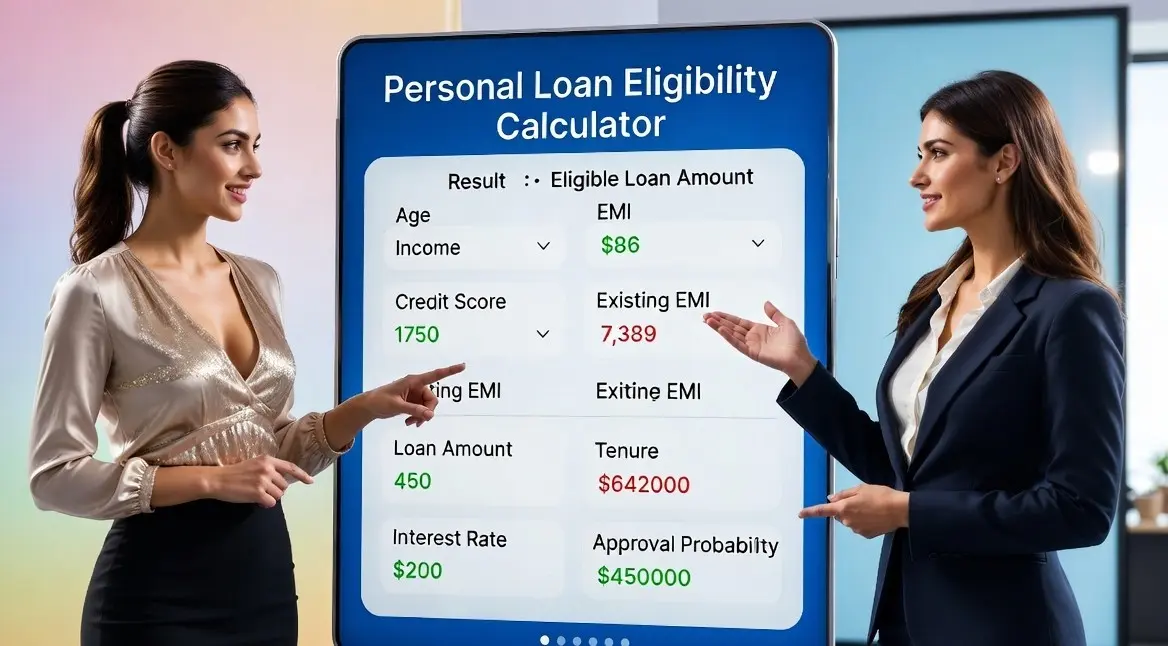
Personal Loan Eligibility by Monthly Salary
Your monthly income is one of the most important factors used by banks and NBFCs to determine your personal loan eligibility. While the actual loan amount depends on your existing EMIs, credit score, FOIR, interest rate, and loan tenure, the table below provides an approximate estimate of the loan amount you may qualify for.
| Monthly Salary | Approx. Eligible Loan Amount |
|---|---|
| ₹25,000 | ₹3 – ₹4 Lakh |
| ₹35,000 | ₹5 – ₹6 Lakh |
| ₹50,000 | ₹7 – ₹9 Lakh |
| ₹60,000 | ₹9 – ₹11 Lakh |
| ₹75,000 | ₹11 – ₹14 Lakh |
| ₹1,00,000 | ₹15 – ₹20 Lakh |
💰 Higher Income
Higher monthly income generally increases your borrowing capacity and improves your maximum eligible loan amount.
📉 Existing EMIs
Lower existing loan obligations leave more room under your FOIR, allowing lenders to approve a higher loan amount.
⭐ Good Credit Score
A CIBIL score of 750 or above can improve approval chances and may help you secure better interest rates.
📅 Longer Loan Tenure
Choosing a longer repayment period may increase your loan eligibility by reducing the monthly EMI.
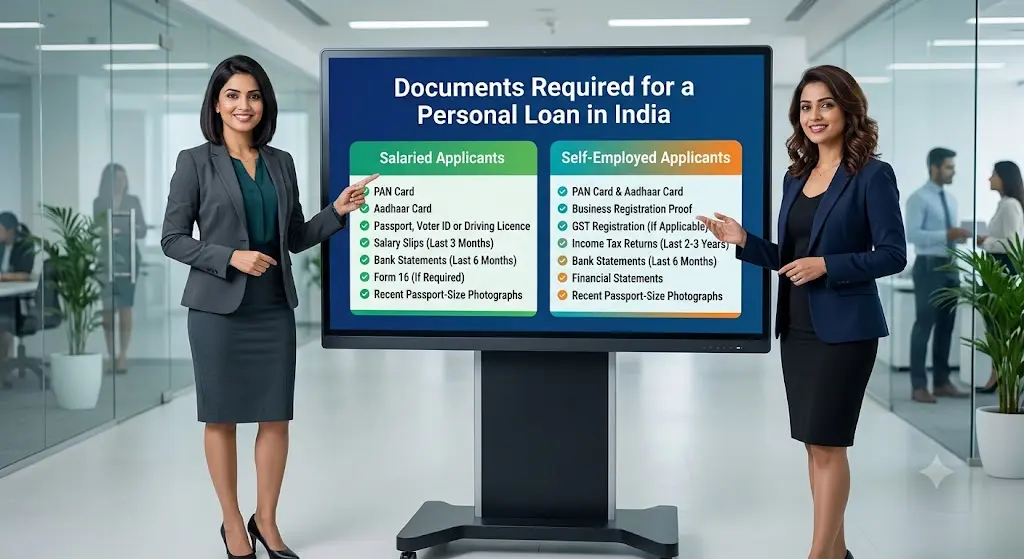
Documents Required for a Personal Loan in India
Once you meet the personal loan eligibility criteria, banks and NBFCs verify your identity, income, employment, and financial stability using supporting documents. Keeping these documents ready can speed up the loan approval process and reduce delays during verification.
Salaried Applicants
- PAN Card
- Aadhaar Card
- Passport, Voter ID or Driving Licence
- Salary Slips (Last 3 Months)
- Bank Statements (Last 6 Months)
- Form 16 (If Required)
- Recent Passport-Size Photographs
Self-Employed Applicants
- PAN Card & Aadhaar Card
- Business Registration Proof
- GST Registration (If Applicable)
- Income Tax Returns (Last 2–3 Years)
- Bank Statements (Last 6 Months)
- Financial Statements
- Recent Passport-Size Photographs
Pro Tip
Keep your KYC documents, income proof, and bank statements updated before applying for a personal loan. Complete and accurate documentation helps lenders verify your profile faster, improves your borrowing experience, and can speed up loan approval.

Common Reasons Why Personal Loan Applications Get Rejected
Even if you meet the basic personal loan eligibility criteria, your loan application may still be rejected due to certain financial or documentation issues. Understanding these common reasons can help you strengthen your application and improve your chances of approval.
1. Low Credit Score
A poor CIBIL score indicates a higher credit risk. Most lenders prefer applicants with a credit score of 750 or above for faster approval and better loan terms.
2. High Existing EMIs
If a significant portion of your monthly income is already committed to existing loan repayments, your FOIR (Fixed Obligation to Income Ratio) may exceed the lender's acceptable limit, reducing your loan eligibility.
3. Insufficient Monthly Income
Applicants with lower or unstable monthly income may not qualify for the desired loan amount, as lenders assess repayment capacity before approving a personal loan.
4. Unstable Employment or Business Income
Frequent job changes, short employment history, or inconsistent business income can make lenders cautious about approving your application.
5. Errors or Incomplete Application
Incorrect personal details, missing documents, or incomplete information can delay processing or lead to outright rejection.
6. Poor Repayment History
Late EMI payments, loan defaults, credit card dues, or loan settlements reflected in your credit report can negatively impact loan approval.
7. Multiple Recent Loan Applications
Submitting several loan applications within a short period results in multiple hard enquiries on your credit report, which may reduce your credit score and affect lender confidence.
8. Incomplete KYC or Income Documents
Missing identity proof, address proof, salary slips, bank statements, or income tax documents can prevent lenders from verifying your eligibility and delay or reject the application.
How to Avoid Personal Loan Rejection
Before applying for a personal loan, review your loan eligibility, maintain a healthy CIBIL score, reduce your existing EMIs, and keep your KYC and income documents up to date. Double-check all information in your application to avoid errors. Using our Personal Loan Eligibility Calculator helps you estimate your borrowing capacity, compare different loan scenarios, and apply with greater confidence.

Tips to Improve Your Chances of Personal Loan Approval
Getting approved for a personal loan depends on more than just meeting the basic eligibility criteria. By following a few smart financial practices before applying, you can strengthen your loan application, improve your credit profile, and increase your chances of faster approval.
✔ Check Your Credit Score Before Applying
Review your CIBIL score before submitting your application. Correct any errors in your credit report and aim for a score of 750 or above to improve approval chances.
✔ Borrow Only What You Need
Apply for a realistic loan amount based on your income and repayment capacity. Requesting an excessively high loan amount may reduce your chances of approval.
✔ Reduce Existing EMIs
Pay off small loans or outstanding credit card balances wherever possible. Lower monthly obligations improve your FOIR (Fixed Obligation to Income Ratio) and borrowing capacity.
✔ Maintain Stable Employment or Business Income
Banks prefer applicants with a stable employment history or consistent business income. Frequent job changes or irregular income may affect loan approval.
✔ Keep Your Documents Ready
Ensure your KYC documents, salary slips, income proof, bank statements, and PAN details are complete and up to date to avoid delays during verification.
✔ Avoid Multiple Loan Applications
Applying to several lenders within a short period can lead to multiple hard enquiries on your credit report, which may negatively impact your credit score.
✔ Choose the Right Loan Tenure
Select a loan tenure that keeps your EMI affordable while matching your repayment capacity. A balanced tenure improves both eligibility and approval prospects.
✔ Compare Multiple Lenders
Eligibility criteria, FOIR limits, interest rates, and maximum loan amounts vary across banks and NBFCs. Compare lenders before applying to find the best option for your financial profile.
Expert Tip
Before applying for a personal loan, use a Personal Loan Eligibility Calculator to estimate your eligible loan amount based on your monthly income, existing EMIs, interest rate, and loan tenure. This helps you apply with confidence, avoid unnecessary loan enquiries, compare lenders, and improve your chances of faster approval.
Frequently Asked Questions (FAQs)
Find answers to the most common questions about the Personal Loan Eligibility Calculator, loan eligibility, CIBIL score, FOIR, required documents, and personal loan approval in India.

Explore More Loan & EMI Calculators
Planning a loan, comparing repayment options, or looking to reduce borrowing costs? Explore our collection of free loan and EMI calculators designed to help you estimate monthly payments, evaluate part-payment strategies, compare loan offers, and make smarter financial decisions.
From home loans and personal loans to car loans, balance transfers, and loan prepayment planning, these calculators provide quick and accurate insights into EMIs, interest costs, repayment schedules, and potential savings. Compare different scenarios, optimize your repayment strategy, and take control of your financial future with confidence.
- Personal Loan EMI Calculator – Monthly EMI Calculator
- Car Loan EMI Calculator – Monthly EMI & Interest Calculator
- Home Loan EMI Calculator – Monthly EMI & Interest Calculator
- Education Loan EMI Calculator – Know EMI Before Course Completion
- Free Business Loan EMI Calculator For MSMEs & Startups
- Loan Against Property EMI Calculator – Calculate LAP EMI Online
- Free Term Loan EMI Calculator – EMI, Interest & Amortization
- Free Loan Balance Transfer Calculator: Calculate EMI Savings
- Bike Loan EMI Calculator – Find The EMI That Fits Your Budget
- Gold Loan EMI Calculator – Calculate EMI & Interest Online
- Commercial Vehicle Loan EMI Calculator With EMI Breakdown
- Term Loan Prepayment Calculator – Calculate Interest Savings
- Loan Part Payment Calculator – Save Interest & Reduce EMI
- Home Loan Eligibility Calculator – Check Maximum Loan Eligibility

Stay Updated with New Finance Tools
Get free calculators, Excel templates, and finance resources delivered to your inbox.
✓ Free Resources • ✓ No Spam • ✓ Unsubscribe Anytime
Disclaimer
The Personal Loan Eligibility Calculator provides an estimated loan eligibility based on the information you enter, including income, existing EMIs, interest rate, loan tenure, and FOIR. The results are for informational purposes only and should not be considered a loan approval or financial advice. Actual loan eligibility, interest rates, and approval decisions may vary depending on the lender's credit policy, credit score, document verification, and other eligibility criteria. Always verify the final loan terms with your bank or NBFC before applying.