
Loan Part Payment Calculator – Save Interest & Become Debt-Free Faster
Use our Loan Part Payment Calculator to compare EMI reduction, tenure reduction, and interest savings.
Make informed prepayment decisions and optimize your loan repayment strategy with accurate savings estimates.
What Is a Loan Part Payment Calculator?
A Loan Part Payment Calculator helps you estimate how an extra lump-sum payment can reduce loan interest costs, lower EMIs, or shorten your repayment tenure. It enables borrowers to compare repayment strategies and identify potential savings before making a loan part payment.
Loan Part Payment Savings Calculator
How Does the Loan Part Payment Calculator Work?
The Loan Part Payment Calculator estimates the impact of making a lump-sum payment on your existing loan. Simply enter your loan amount, interest rate, remaining tenure, and proposed part payment amount. The calculator then analyzes how the additional payment affects your outstanding balance and repayment schedule.
Depending on your lender’s policy, you can compare two common repayment options:
- Reduce EMI: Lower your monthly EMI while keeping the remaining tenure unchanged.
- Reduce Tenure: Keep your EMI unchanged and shorten the loan repayment period.
The calculator instantly estimates interest savings, EMI reduction, tenure reduction, and the revised amortization schedule, helping you choose the most cost-effective repayment strategy.


Benefits of Using a Loan Part Payment Calculator
Making a loan part payment can significantly reduce your overall borrowing cost, but the actual impact depends on factors such as the payment amount, remaining loan tenure, interest rate, and repayment strategy selected. A Loan Part Payment Calculator helps you evaluate these factors instantly, allowing you to make informed financial decisions before committing additional funds toward your loan. Whether your goal is to reduce monthly EMIs, shorten the repayment period, or maximize interest savings, this tool provides valuable insights into the long-term benefits of loan prepayments.
Save on Total Interest Costs
A well-timed part payment can significantly reduce the total interest payable over the life of the loan.
Compare EMI vs Tenure Reduction
Understand whether reducing your EMI or shortening your loan tenure provides greater financial benefits.
Improve Loan Repayment Planning
Evaluate different part payment scenarios before making a financial commitment.

Become Debt-Free Faster
Discover how extra payments can help you repay your loan ahead of schedule and reduce long-term debt obligations.
Make Smarter Financial Decisions
Use accurate calculations to optimize home loans, personal loans, car loans, and other installment-based loans.
View Detailed Repayment Analysis
Access a revised amortization schedule showing outstanding balance, principal repayment, interest costs, and projected savings.

How to Use This Loan Part Payment Calculator
- Enter your outstanding loan balance, interest rate, and remaining loan tenure.
- Select the proposed part payment amount and the month in which you plan to make the payment.
- Choose whether you want to reduce your EMI or shorten your loan tenure.
- Click Calculate to view revised loan details, interest savings, EMI impact, and tenure reduction.
- Compare repayment options and choose the strategy that best suits your financial goals.
EMI Reduction vs Tenure Reduction: Which Option Is Better?
When making a loan part payment, lenders generally offer two repayment options: reducing your monthly EMI or reducing the remaining loan tenure. Choosing the right option depends on your financial goals, cash flow requirements, and long-term interest-saving objectives.

Reduce EMI
Under this option, the remaining loan tenure stays unchanged, but your monthly EMI decreases. This can improve monthly cash flow and make loan repayments more manageable.
Best for:
- Borrowers seeking lower monthly obligations
- Households managing tight cash flow
- Individuals expecting future financial commitments

Reduce Tenure
With this option, your EMI remains unchanged, but the loan repayment period is shortened. Since the outstanding balance is repaid faster, total interest costs are usually lower compared to EMI reduction.
Best for:
- Borrowers aiming to maximize interest savings
- Individuals with stable income
- Those seeking faster debt repayment
Which Option Saves More Money?
In most cases, reducing the loan tenure results in greater interest savings because the loan is repaid over a shorter period. However, borrowers prioritizing monthly affordability may prefer EMI reduction. This Loan Part Payment Calculator allows you to compare both scenarios and identify the most suitable repayment strategy based on your financial goals.

Factors That Affect Loan Part Payment Savings
The amount of interest savings generated through a loan part payment depends on several factors. Understanding these factors can help borrowers maximize the benefits of prepaying their loans and make more informed repayment decisions.
Outstanding Loan Balance
The higher the remaining loan balance, the greater the potential impact of a part payment on future interest costs.
Remaining Loan Tenure
Part payments made early in the loan tenure generally result in higher interest savings because a larger portion of future interest payments can be avoided.
Loan Interest Rate
Loans with higher interest rates typically generate greater savings from part payments compared to low-interest loans.

Part Payment Amount
Larger part payments reduce the outstanding principal more significantly, leading to greater EMI reductions, shorter loan tenures, and increased interest savings.
Timing of Part Payment
Making a part payment earlier during the repayment period usually provides more financial benefits than making the same payment closer to the end of the loan term.
Repayment Option Selected
Choosing tenure reduction often results in higher overall interest savings, while EMI reduction provides immediate monthly cash flow relief.
Example Loan Part Payment Calculation
Let’s assume a borrower has an outstanding loan balance of ₹30,00,000 at an interest rate of 8.50% per annum with 15 years remaining. The borrower makes a lump-sum part payment of ₹5,00,000 and chooses to reduce the loan tenure while keeping the EMI unchanged.
| Particulars | Value |
|---|---|
| Outstanding Loan Balance | ₹30,00,000 |
| Interest Rate | 8.50% p.a. |
| Remaining Tenure | 15 Years |
| Monthly EMI | ₹29,542 |
| Part Payment Amount | ₹5,00,000 |
| Repayment Option | Reduce Tenure |

When Should You Make a Loan Part Payment?
Making a loan part payment can be an effective strategy to reduce loan interest costs, lower outstanding debt, and improve overall financial health. However, the amount of savings generated depends largely on the timing of the payment, the remaining loan tenure, the interest rate, and the repayment option selected. Understanding when to make a loan part payment can help borrowers maximize interest savings and achieve faster loan repayment.
Make Part Payments Early in the Loan Tenure
The best time to make a loan part payment is usually during the early years of the loan. Since a larger portion of each EMI goes toward interest during the initial repayment period, reducing the principal balance early can result in substantial long-term interest savings.
Use Bonuses, Incentives, or Windfall Income
Annual bonuses, performance incentives, maturity proceeds, inheritance funds, or other lump-sum receipts can be used strategically to reduce outstanding loan balances. Using surplus funds for loan part payments may provide a guaranteed return in the form of interest savings.
Consider Part Payments When Interest Rates Are High
Borrowers paying higher loan interest rates often benefit more from loan part payments because every reduction in principal directly decreases future interest costs. This can significantly improve the overall cost of borrowing.
Ensure Adequate Emergency Savings First
Before making a loan part payment, maintain a sufficient emergency fund to cover unexpected expenses, medical emergencies, or temporary income disruptions. Loan repayment should not compromise financial stability.
Evaluate EMI Reduction vs Tenure Reduction
A loan part payment calculator can help compare EMI reduction and tenure reduction options. In many cases, reducing the loan tenure provides higher interest savings, while EMI reduction improves monthly cash flow and affordability.
Before Opting for Loan Refinancing
If you’re considering a balance transfer or refinancing option, it may be worthwhile to evaluate whether a part payment alone can achieve similar savings. This can help avoid additional processing fees and administrative costs associated with refinancing.

Key Takeaway
For most borrowers, making a loan part payment during the first one-third of the loan tenure delivers the greatest financial benefit. Use the Loan Part Payment Calculator above to compare different repayment scenarios, estimate interest savings, and identify the most effective loan repayment strategy based on your financial goals.
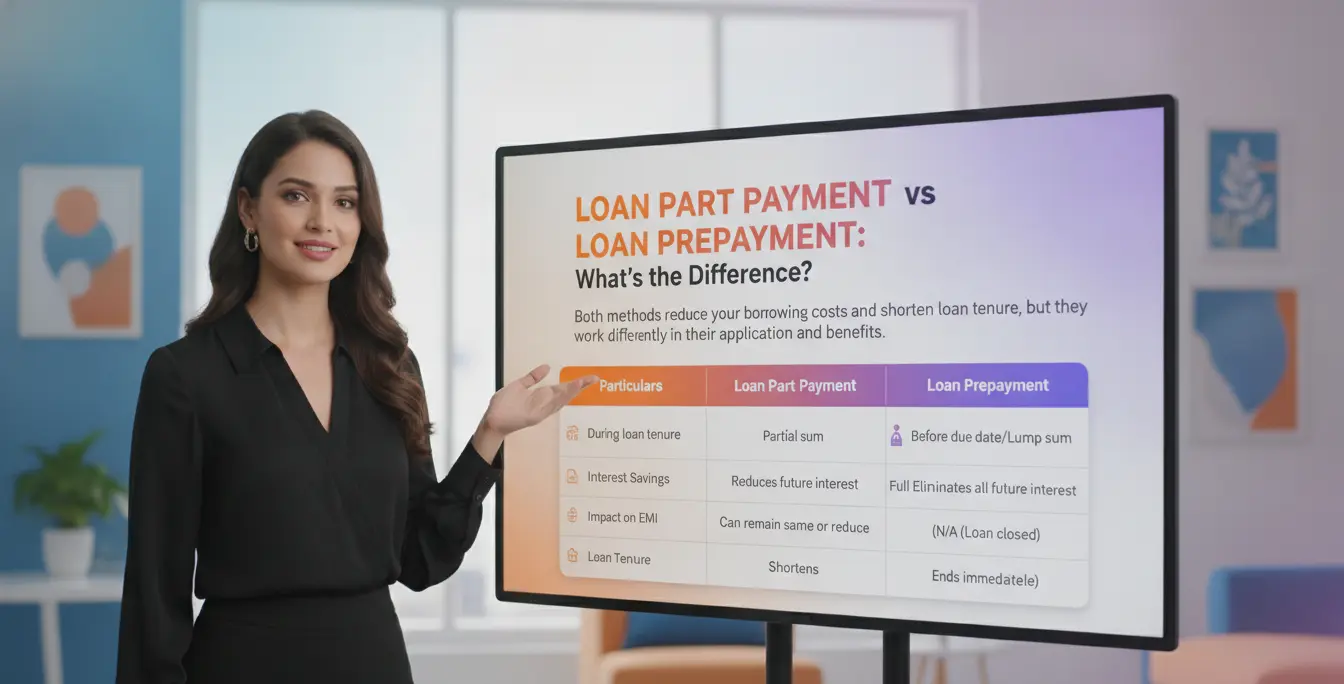
Loan Part Payment vs Loan Prepayment: What’s the Difference?
Many borrowers use the terms loan part payment and loan prepayment interchangeably. While both help reduce borrowing costs and save interest, they work differently and may have different impacts on your loan repayment schedule.
| Particulars | Loan Part Payment | Loan Prepayment |
|---|---|---|
| Definition | Partial repayment of the outstanding loan balance. | Complete repayment of the remaining loan balance before maturity. |
| Loan Status | Loan continues after payment. | Loan account is fully closed. |
| Outstanding Balance | Reduced partially. | Reduced to zero. |
| EMI Impact | EMI may reduce or tenure may shorten. | Future EMIs stop completely. |
| Interest Savings | Saves future interest on the part-paid amount. | Eliminates all future interest obligations. |
| Suitable For | Borrowers with surplus funds but who wish to continue the loan. | Borrowers capable of clearing the entire outstanding loan. |
| Cash Requirement | Requires only a partial lump-sum payment. | Requires payment of the full outstanding balance. |
| Financial Flexibility | Higher flexibility with lower cash outflow. | Requires significant liquidity. |
Frequently Asked Questions About Loan Part Payments

Explore More Loan & EMI Calculators
Planning a loan, comparing repayment options, or looking to reduce borrowing costs? Explore our collection of free loan and EMI calculators designed to help you estimate monthly payments, evaluate part-payment strategies, compare loan offers, and make smarter financial decisions.
From home loans and personal loans to car loans, balance transfers, and loan prepayment planning, these calculators provide quick and accurate insights into EMIs, interest costs, repayment schedules, and potential savings. Compare different scenarios, optimize your repayment strategy, and take control of your financial future with confidence.
- Personal Loan EMI Calculator – Monthly EMI Calculator
- Car Loan EMI Calculator – Monthly EMI & Interest Calculator
- Home Loan EMI Calculator – Monthly EMI & Interest Calculator
- Education Loan EMI Calculator – Know EMI Before Course Completion
- Free Business Loan EMI Calculator For MSMEs & Startups
- Loan Against Property EMI Calculator – Calculate LAP EMI Online
- Free Term Loan EMI Calculator – EMI, Interest & Amortization
- Free Loan Balance Transfer Calculator: Calculate EMI Savings
- Bike Loan EMI Calculator – Find The EMI That Fits Your Budget
- Gold Loan EMI Calculator – Calculate EMI & Interest Online
- Commercial Vehicle Loan EMI Calculator With EMI Breakdown
- Term Loan Prepayment Calculator – Calculate Interest Savings
- Personal Loan Eligibility Calculator – Check Loan Eligibility
- Home Loan Eligibility Calculator – Check Maximum Loan Eligibility

Stay Updated with Smart Financial Tools
Get free access to new loan calculators, EMI planning tools, personal finance resources, and practical money-saving tips delivered straight to your inbox.
Subscribe today and make smarter financial decisions with confidence.
Disclaimer
The Term Loan Prepayment Calculator is provided for informational and educational purposes only. Results are estimates based on the inputs provided and may differ from actual lender calculations, repayment schedules, interest accrual methods, prepayment policies, charges, and loan terms. Interest savings, revised EMI, tenure reduction, and other projections are illustrative and should not be considered financial advice.
Before making any loan prepayment decision, consult your lender and review the applicable loan agreement, prepayment charges, foreclosure terms, and repayment conditions. ToolSuite.in does not guarantee the accuracy, completeness, or suitability of the results for any specific financial situation.