
Debt-to-Income Ratio Calculator for Home, Car & Personal Loans
Find out how much of your monthly income goes toward debt repayments and check whether your DTI (FOIR) falls within the range commonly preferred by lenders for loan approval.
✓ Free Forever • Instant Results • No Sign-up • 100% Private • Trusted Loan Formula
Debt-to-Income (DTI) Ratio at a Glance

Debt-to-Income (DTI / FOIR) Calculator
See what share of your income goes toward debt — the same check lenders run before approving any loan
(Housing Only)
(All Debt)
⚠️ This is an indicative estimate for personal financial planning. Individual lenders set their own DTI/FOIR limits and may calculate income and debt differently.
DTI and FOIR Are the Same Thing
Debt-to-Income (DTI) is the term used internationally; FOIR (Fixed Obligation to Income Ratio) is the same calculation, just the term Indian banks use. Both measure what share of your income is already committed to debt payments.
Front-end DTI looks at housing costs alone (rent or home loan EMI) against income. Back-end DTI — the number lenders usually care about most — includes every debt obligation: housing, credit cards, car loans, personal loans, and student loans.
General guidance: back-end DTI under 36% is considered healthy by most lenders, 36–43% is borderline, and above 43% often limits how much more you can borrow — though exact thresholds vary by lender and loan type.
📉 Lowering Your DTI
- Pay down high-EMI debts first — clearing a credit card or personal loan moves the needle faster than a large loan with a small EMI.
- Avoid new debt before a big loan application — a new car EMI right before a home loan application can push your DTI over the threshold.
- Increase your income — even documented freelance or rental income can improve your ratio if a lender counts it.
- Consider a co-applicant — combining incomes on a joint application can bring the household DTI down.

What Is a Debt-to-Income (DTI) Ratio?
A Debt-to-Income (DTI) Ratio is the percentage of your gross monthly income that goes toward repaying monthly debt obligations, such as home loan EMIs, car loans, personal loans, and credit card payments. Also known as FOIR (Fixed Obligation to Income Ratio) in India, this ratio helps banks and lenders evaluate your repayment capacity before approving a loan. Use this free Debt-to-Income Ratio Calculator to instantly calculate your DTI and understand your borrowing capacity and loan eligibility.

What Is a Good Debt-to-Income (DTI) Ratio?
A good Debt-to-Income (DTI) ratio generally depends on the lender and the type of loan, but a back-end DTI below 36% is widely considered healthy. A lower DTI indicates that a smaller portion of your monthly income is committed to existing debt, which may improve your chances of qualifying for new credit. While some lenders accept DTI ratios up to 43%, higher ratios may result in stricter eligibility requirements, lower loan amounts, or higher interest rates.
| DTI Ratio | Assessment | Typical Impact |
|---|---|---|
| Below 20% | ⭐ Excellent | Strong borrowing capacity with low debt burden. |
| 20%–35% | ✅ Good | Generally preferred by many lenders for loan approval. |
| 36%–43% | ⚠ Acceptable | May qualify depending on credit score, income, and lender policies. |
| 44%–50% | 🔶 High | Higher debt burden may reduce borrowing capacity. |
| Above 50% | ❌ Poor | Loan approval becomes more difficult without improving financial position. |

Tip: Besides your DTI ratio, lenders also consider factors such as your credit score, income stability, employment history, existing loan repayment record, and loan-to-value (LTV) ratio before making a lending decision.

How Do Lenders Use Your Debt-to-Income (DTI) Ratio?
Your Debt-to-Income (DTI) ratio helps lenders evaluate whether you can comfortably manage another loan alongside your existing financial commitments. While a low DTI does not guarantee approval, it indicates that you have sufficient income available to meet additional monthly repayments. Most banks and financial institutions review your DTI together with other financial factors before making a lending decision.
Lenders typically consider:
- Monthly income to verify your repayment capacity.
- Existing EMIs and debt obligations to assess your financial commitments.
- Credit score and repayment history to measure creditworthiness.
- Employment and income stability for consistent cash flow.
- Loan amount and repayment tenure to determine affordability.
- Loan-to-Value (LTV) ratio for secured loans such as home loans.
Remember: A lower DTI ratio improves your financial profile, but final loan approval depends on the lender’s credit policy, your credit history, and overall financial health.


Factors That Affect Your Debt-to-Income (DTI) Ratio
Your Debt-to-Income (DTI) ratio changes whenever your monthly income or debt obligations change. Understanding these factors can help you improve your borrowing capacity and increase your chances of qualifying for a loan.
The main factors that influence your DTI ratio include:
- Gross Monthly Income: A higher monthly income reduces your DTI ratio if your debt remains unchanged.
- Home Loan or Rent: Housing costs usually represent the largest monthly financial commitment and have a significant impact on your DTI.
- Existing Loan EMIs: Car loans, personal loans, education loans, and other EMIs increase your monthly debt obligations.

- Credit Card Payments: Minimum monthly credit card payments are generally included when calculating your DTI.
- New Loan Applications: Taking a new loan increases your monthly debt burden and may raise your DTI ratio.
- Changes in Income: Salary hikes, bonuses (where considered), or additional regular income can improve your DTI ratio by increasing your repayment capacity.
Tip: You can lower your DTI by increasing your monthly income, paying off existing debts, avoiding unnecessary borrowing, or choosing a longer repayment tenure to reduce monthly EMIs.

DTI Vs. FOIR
Yes. Debt-to-Income (DTI) Ratio and Fixed Obligation to Income Ratio (FOIR) measure the same core concept—how much of your gross monthly income is used to repay existing debt obligations. The primary difference is the terminology used.
In the United States and many international markets, lenders commonly refer to this metric as the Debt-to-Income (DTI) Ratio. In India, banks, NBFCs, and housing finance companies more often use the term FOIR (Fixed Obligation to Income Ratio) when assessing loan eligibility.
Regardless of the name, both ratios compare your total monthly debt payments with your gross monthly income to evaluate your repayment capacity.
| Debt-to-Income (DTI) | FOIR (Fixed Obligation to Income Ratio) |
|---|---|
| Commonly used in the U.S. and globally | Commonly used by Indian lenders |
| Measures monthly debt against gross income | Measures fixed monthly obligations against gross income |
| Used for loan affordability assessment | Used for loan eligibility assessment |
| Calculation method is the same | Calculation method is the same |
In simple terms: If you’re applying for a loan in India, your bank may refer to your DTI ratio as FOIR, but both represent the same financial metric used to assess your ability to repay a loan.


Front-End vs. Back-End Debt-to-Income (DTI) Ratio
When evaluating a loan application, lenders may calculate two types of Debt-to-Income (DTI) ratios: Front-End DTI and Back-End DTI. Although both measure your repayment capacity, they include different monthly expenses and serve different purposes during the credit assessment process.
The Front-End Debt-to-Income (DTI) Ratio, also known as the Housing Ratio, measures the percentage of your gross monthly income spent on housing-related expenses, such as your home loan EMI or rent. It is primarily used to evaluate housing affordability, especially for home loan applications.
The Back-End Debt-to-Income (DTI) Ratio measures the percentage of your gross monthly income used to repay all recurring monthly debt obligations, including housing costs and other loan repayments. Since it reflects your overall debt burden, most lenders use this ratio to assess your loan eligibility and repayment capacity.
Front-End DTI vs. Back-End DTI
| Comparison | 🏠 Front-End DTI | 💳 Back-End DTI |
|---|---|---|
| Also Known As | Housing Ratio | Total Debt Ratio / FOIR |
| Measures | Housing expenses only | All monthly debt obligations |
| Home Loan EMI / Rent | ✅ Included | ✅ Included |
| Car Loan EMI | ❌ Not Included | ✅ Included |
| Personal Loan EMI | ❌ Not Included | ✅ Included |
| Education Loan EMI | ❌ Not Included | ✅ Included |
| Credit Card Payments | ❌ Not Included | ✅ Included |
| Primary Purpose | Housing affordability | Overall repayment capacity |
| Most Commonly Used By Lenders | Sometimes | ✅ Yes |

💡 Key Takeaway
While both ratios are useful, most banks and financial institutions primarily evaluate the Back-End DTI (also known as FOIR in India) because it considers all your existing monthly debt obligations. Unless a lender specifically refers to the Front-End DTI, the term Debt-to-Income (DTI) Ratio generally refers to the Back-End DTI used to assess overall loan eligibility.
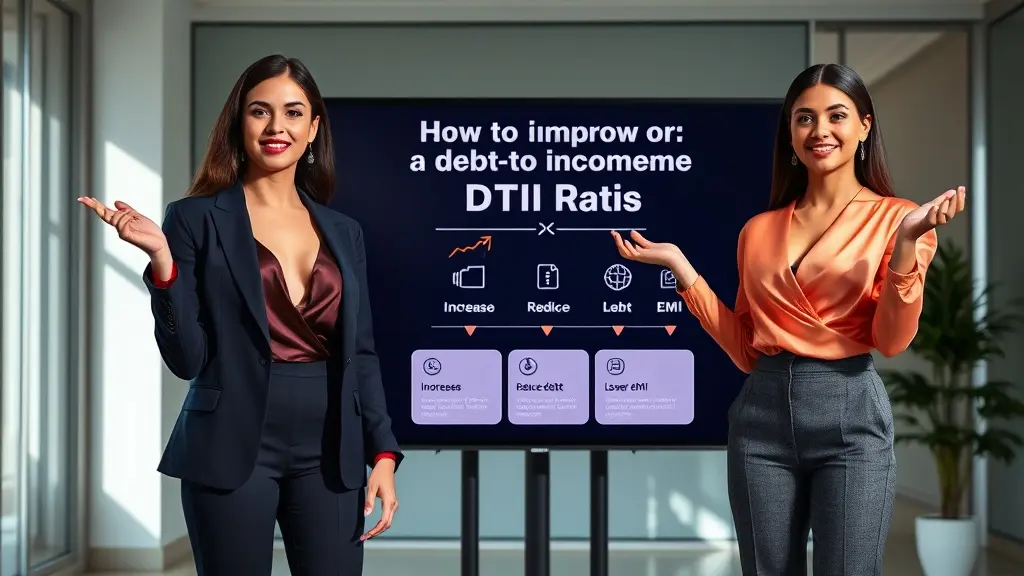
How to Improve Your Debt-to-Income (DTI) Ratio
If your Debt-to-Income (DTI) ratio is higher than the range preferred by lenders, improving it can increase your borrowing capacity and strengthen your loan application. Since DTI is based on your monthly debt obligations and gross monthly income, even small financial changes can make a noticeable difference over time.
You can improve your DTI ratio by:
- Paying off existing loans to reduce your monthly EMI commitments.
- Reducing outstanding credit card balances and avoiding high revolving debt.
- Increasing your monthly income through salary growth, additional work, or other stable income sources.
- Avoiding new loans or unnecessary credit before applying for financing.
- Refinancing or consolidating debt to lower your monthly repayments, where appropriate.
- Choosing a longer loan tenure if it reduces your monthly EMI and fits your overall financial goals.
Remember: A lower DTI ratio improves your financial profile, but lenders also consider your credit score, repayment history, employment stability, and overall income before approving a loan.

Frequently Asked Questions (FAQs)-DTI Ratio

Explore More Loan & Finance Calculators
Planning your borrowing goes beyond calculating your maximum loan amount. Explore our loan and finance calculators to calculate EMIs, check loan eligibility, compare interest rates, estimate repayment periods, evaluate prepayment savings, and understand your total borrowing costs. Whether you’re planning a home loan, personal loan, car loan, education loan, or business loan, these tools help you compare different scenarios, assess affordability, and make smarter borrowing decisions with confidence.
- Personal Loan EMI Calculator – Monthly EMI Calculator
- Car Loan EMI Calculator – Monthly EMI & Interest Calculator
- Home Loan EMI Calculator – Monthly EMI & Interest Calculator
- Education Loan EMI Calculator – Know EMI Before Course Completion
- Free Business Loan EMI Calculator For MSMEs & Startups
- Loan Against Property EMI Calculator – Calculate LAP EMI Online
- Free Term Loan EMI Calculator – EMI, Interest & Amortization
- Free Loan Balance Transfer Calculator: Calculate EMI Savings
- Bike Loan EMI Calculator – Find The EMI That Fits Your Budget
- Gold Loan EMI Calculator – Calculate EMI & Interest Online
- Commercial Vehicle Loan EMI Calculator With EMI Breakdown
- Term Loan Prepayment Calculator – Calculate Interest Savings
- Loan Part Payment Calculator – Save Interest & Reduce EMI
- Home Loan Eligibility Calculator – Check Maximum Loan Eligibility
- Personal Loan Eligibility Calculator – Check Loan Eligibility
- Home Loan Affordability Calculator – Estimate Home Buying Budget
- Loan Tenure Calculator – Calculate Loan Duration From EMI
- Compare Loan Offers Online | Free Loan Comparison Calculator
- Loan Interest Rate Calculator (EMI To Interest Rate) – Free Online
- Loan Amount Calculator – Calculate Maximum Loan Amount From EMI

Never Miss a Better Loan Decision
Get the latest loan calculators, EMI planning tips, interest rate insights, repayment strategies, and personal finance guides delivered straight to your inbox.
Disclaimer
The Debt-to-Income (DTI / FOIR) Calculator is provided for informational and educational purposes only. Results are estimates based on the information you enter and standard DTI calculation methods. Actual loan eligibility, approved amount, interest rate, EMI, and lending terms may vary by lender and depend on factors such as income, credit history, existing obligations, and internal lending policies. ToolSuite does not guarantee loan approval or any specific lending outcome. This calculator should not be considered financial or credit advice.