
Data Storage Converter – KB, MB, GB & TB
Convert Bytes, KB, MB, GB, TB, and other digital storage units instantly using this fast and accurate online Data Storage Converter tool.
✓ Instant Conversion • ✓ Binary & Decimal Support • ✓ Accurate Results • ✓ Free Online Tool
Toolsuite Advance — Data Storage Converter
Convert data storage units instantly including bytes, kilobytes, megabytes, gigabytes, terabytes and petabytes.
Convert Data Storage
Conversion Result

How to Use the Data Storage Converter
This Data Storage Converter helps you quickly convert digital storage units such as Bytes, KB, MB, GB, TB, and more. Whether you are checking file sizes, comparing storage capacity, or calculating digital data measurements, the tool provides fast and accurate conversion results instantly.
To use this converter:
- Enter the storage value you want to convert
- Select the current storage unit
- Choose the target conversion unit
- Instantly get the converted result
This tool supports both binary and decimal storage calculations for better accuracy and compatibility across different devices and storage systems.
Data Storage Units Supported by This Tool
This online Data Storage Converter supports a wide range of digital storage units commonly used in computers, smartphones, cloud storage, servers, SSDs, hard drives, software downloads, and networking systems. Understanding these storage units makes it easier to compare file sizes, storage capacity, and digital data measurements accurately.
Byte (B)
A Byte is the basic unit of digital storage used to store a single character or small amount of data.
Kilobyte (KB)
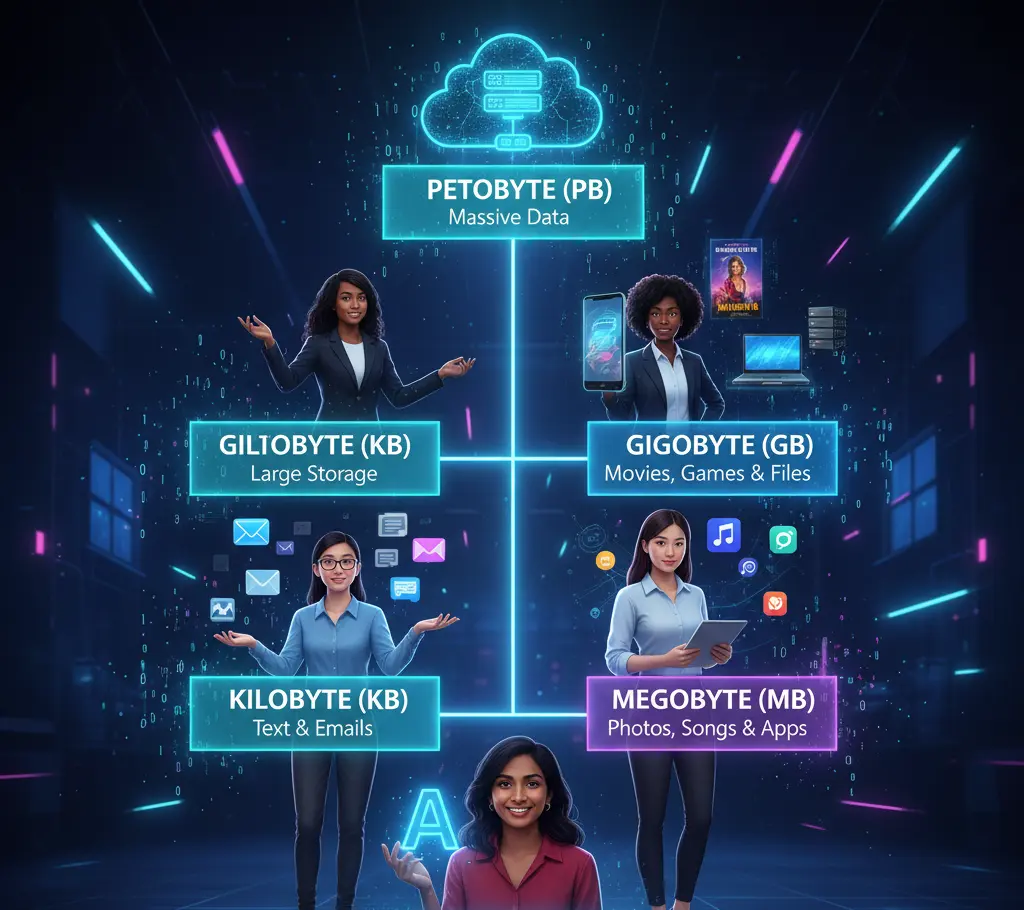
Kilobytes are commonly used for small files such as text documents, emails, and simple images.
Megabyte (MB)
Megabytes are typically used to measure photos, songs, PDFs, applications, and mobile file sizes.
Gigabyte (GB)
Gigabytes are widely used for smartphones, movies, games, SSDs, cloud storage, and computer storage capacity.
Terabyte (TB)
Terabytes are mainly used for large storage devices, servers, backups, and high-capacity hard drives.
Petabyte (PB)
Petabytes represent extremely large amounts of digital data and are commonly used in enterprise systems, data centers, and cloud computing environments.

Data Storage Conversion Chart
The table below shows some of the most commonly used digital storage conversions. This quick reference chart can help you understand the relationship between different storage units more easily while comparing file sizes, SSD capacity, hard drives, cloud storage, and digital data measurements.
| Storage Unit | Equivalent Value |
|---|---|
| 1 Kilobyte (KB) | 1,024 Bytes |
| 1 Megabyte (MB) | 1,024 KB |
| 1 Gigabyte (GB) | 1,024 MB |
| 1 Terabyte (TB) | 1,024 GB |
| 1 Petabyte (PB) | 1,024 TB |
These values are based on the binary storage calculation system commonly used in computers and operating systems. Some storage manufacturers may use decimal calculations, where units are measured in multiples of 1,000 instead of 1,024.

Binary vs Decimal Storage Units
Digital storage is measured using two different calculation systems: binary storage units and decimal storage units. Binary units are based on multiples of 1,024 and are commonly used by operating systems and computer memory calculations, whereas decimal units are based on multiples of 1,000 and are mainly used by SSD, hard drive, USB, and storage manufacturers for product labeling and marketing purposes. Because of this difference, the available storage shown on your computer may sometimes appear lower than the advertised storage capacity of a device.
| Feature | Binary Units | Decimal Units |
|---|---|---|
| Calculation Base | 1,024 | 1,000 |
| Commonly Used By | Operating Systems | Storage Manufacturers |
| Example | 1 MB = 1,024 KB | 1 MB = 1,000 KB |
| Common Terms | KiB, MiB, GiB | KB, MB, GB |
| Usually Seen In | Windows, Linux, RAM | SSDs, HDDs, USB Drives |
Where Data Storage Conversion Is Commonly Used
Data storage conversion is useful in many everyday digital activities, especially when comparing file sizes, managing storage capacity, or understanding data measurements across different devices and platforms. Converting storage units correctly helps users avoid confusion while working with files, cloud storage, software downloads, and digital devices.
Refer below the common use cases of Data Storage Converter.

SSDs & Hard Drives
Storage conversion is commonly used to compare SSD and hard drive capacity while purchasing laptops, desktops, or external storage devices.
Cloud Storage Platforms
Cloud services such as Google Drive, OneDrive, and Dropbox often display storage limits in GB or TB, making conversion useful for managing available space.
Smartphones & Mobile Devices
Mobile users frequently compare app sizes, photos, videos, and phone storage capacity using MB and GB measurements.

Gaming & Software Downloads
Modern games and software applications can require large amounts of storage space, making GB and TB conversions important before downloading or installing files.
Video, Photos & Media Files
Photographers, editors, and content creators often work with large media files where storage conversion helps estimate project size and backup requirements.
Servers & Data Centers
Large-scale servers and enterprise systems use TB and PB measurements to manage huge amounts of digital data and storage infrastructure.
Frequently Asked Questions
Related Unit Conversion Tools
Looking for more measurement and conversion Utilities? Explore these related unit conversion tools to quickly convert different values with speed, accuracy, and ease.
Explore More Conversion Tools Below:

- Length Converter – Convert meters, kilometers, feet, inches, miles, and more instantly.
- Weight Converter – Convert kilograms, grams, pounds, ounces, and other weight units with precision.
- Area Converter – Easily convert square meters, acres, hectares, square feet, and more.
- Volume Converter – Convert liters, milliliters, gallons, cubic meters, and other volume measurements quickly.
- Temperature Converter – Instantly switch between Celsius, Fahrenheit, and Kelvin for accurate temperature conversion.
- Speed Converter – Convert Km/h, Mph, M/s & Knots Instantly
- Free Time Converter – Convert Seconds, Minutes, Hours & Days Online
- Fuel Efficiency Converter – Convert Km/L, MPG & L/100km Online
 Convert digital storage units instantly with our fast and accurate Data Storage Converter tool.
- Easily compare file sizes, SSD capacity, and cloud storage using this free online storage converter.
- Quickly convert Bytes, KB, MB, GB, and TB for files, devices, and digital storage calculations.