

Introduction
Choosing between a personal loan vs home loan EMI is one of those decisions that looks simple on the surface—but has long-term financial consequences if misunderstood.
Most borrowers focus on the EMI amount alone. The lower number feels comfortable, the higher one feels risky. But that’s a narrow way to look at it. What really matters is how that EMI is structured—the interest rate behind it, the tenure over which it runs, and the total cost you end up paying.
This is where the comparison between a personal loan vs home loan becomes meaningful. One offers speed and flexibility at a higher cost; the other offers stability and tax efficiency, but over a longer horizon.
The real question isn’t which loan is cheaper—it’s how the EMI of a personal loan vs home loan fits into your monthly cash flow and long-term plans.
Before you make that decision, it’s worth running both scenarios once:
🔗 Use our Loan EMI Calculator to compare instantly
Personal Loan vs Home Loan Difference
At a surface level, the distinction is simple: a personal loan is unsecured, while a home loan is backed by property. But that single difference quietly reshapes everything else—interest rates, tenure, and ultimately, your EMI burden.
A personal loan carries higher risk for the lender. That risk is priced into the loan through higher interest rates—often in the low-to-mid teens. Add to that a shorter repayment window, typically three to five years, and the result is a compressed repayment structure with significantly higher EMIs. You gain speed and flexibility, but at a cost that shows up every month.
A home loan, by contrast, operates on a different architecture. The presence of collateral reduces risk, allowing lenders to offer lower interest rates and much longer tenures, sometimes extending up to 20–30 years. This spreads the repayment over time, resulting in a far more manageable EMI, even if the total interest paid over the life of the loan may be higher.
Before going further, it helps to step back and look at both side by side:
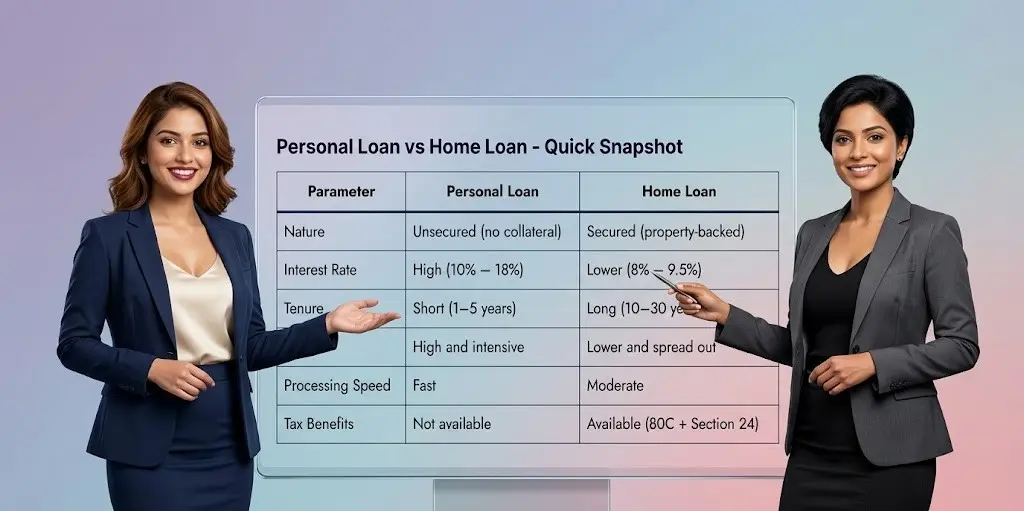
Personal Loan vs Home Loan EMI – Quick Snapshot
| Parameter | Personal Loan | Home Loan |
|---|---|---|
| Nature | Unsecured (no collateral) | Secured (property-backed) |
| Interest Rate | High (10% – 18%) | Lower (8% – 9.5%) |
| Tenure | Short (1–5 years) | Long (10–30 years) |
| EMI | High and intensive | Lower and spread out |
| Processing Speed | Fast | Moderate |
| Tax Benefits | Not available | Available (80C + Section 24) |
What emerges from this comparison is not just a difference in cost, but a difference in financial behaviour.
A personal loan concentrates the burden into a shorter period. A home loan distributes it across time.
If you want to see how sharply this plays out in actual numbers, it’s worth testing both scenarios yourself:
🔗 Compare EMI instantly using our Loan EMI Calculator
EMI Comparison – What the Numbers Actually Reveal
The difference between a personal loan vs home loan EMI becomes immediately clear when you put real numbers on the table.
Take a simple scenario: a ₹10 lakh loan.
A personal loan at around 14% for five years results in an EMI that is sharply higher—often more than double that of a home loan. The reason is not just the interest rate, but the compressed tenure. You are effectively repaying the entire loan in a short window, which intensifies the monthly outflow.
Now compare that with a home loan at 9% over 20 years. The EMI drops significantly because the repayment is spread out. It feels easier on the cash flow, even though the total interest paid over time may be higher.
This is where the EMI comparison of personal loan vs home loan becomes critical. The decision is less about affordability today and more about sustainability over time.
👉 To see this difference with your own numbers:
🔗 Use our Loan EMI Calculator to compare both options
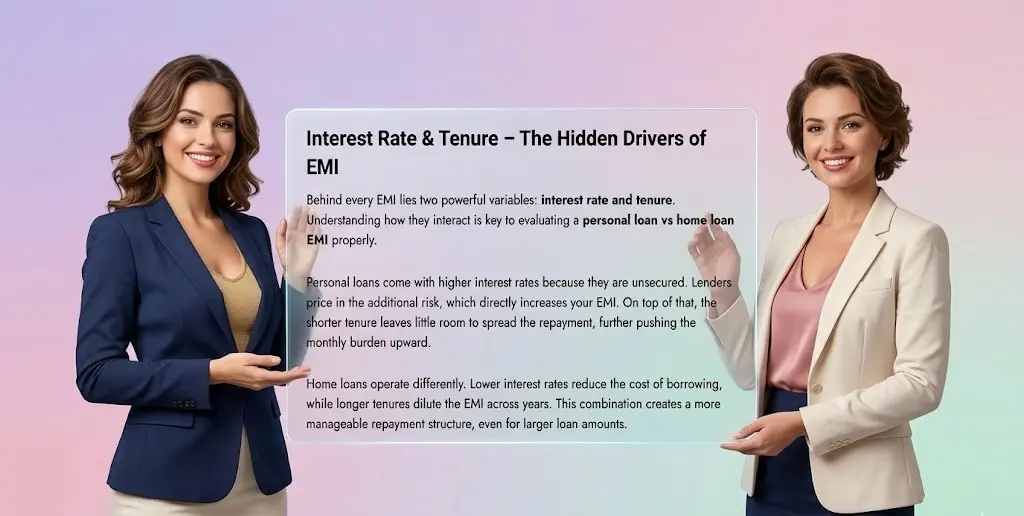
Interest Rate & Tenure – The Hidden Drivers of EMI
Behind every EMI lies two powerful variables: interest rate and tenure. Understanding how they interact is key to evaluating a personal loan vs home loan EMI properly.
Personal loans come with higher interest rates because they are unsecured. Lenders price in the additional risk, which directly increases your EMI. On top of that, the shorter tenure leaves little room to spread the repayment, further pushing the monthly burden upward.
Home loans operate differently. Lower interest rates reduce the cost of borrowing, while longer tenures dilute the EMI across years. This combination creates a more manageable repayment structure, even for larger loan amounts.
However, there’s a trade-off. A longer tenure reduces EMI but increases the total interest paid. This is why comparing personal loan vs home loan interest and EMI together gives a more accurate picture than looking at EMI alone.
👉 Test how rate and tenure impact your EMI:
🔗 Calculate instantly using our EMI Calculator
Tax Benefits – The Silent Advantage of Home Loans
One of the most overlooked aspects in a personal loan vs home loan EMI comparison is taxation.
A personal loan, despite its flexibility, offers no meaningful tax benefit in most cases. You repay both principal and interest entirely from your post-tax income. The EMI may already feel high—and there’s no relief from the tax side.
A home loan changes that equation.
Under current tax provisions, you can claim:
- Deduction on interest (up to ₹2 lakh)
- Deduction on principal under Section 80C
This effectively reduces your real cost of borrowing. In practical terms, the EMI of a home loan becomes lighter after tax adjustment, something a personal loan simply cannot offer.
If you’re evaluating both options, don’t rely on assumptions—run the numbers properly:
🔗 Check Home Loan EMI with tax impact using our Home Loan Calculator
🔗 Compare with Personal Loan EMI using our Personal Loan Calculator
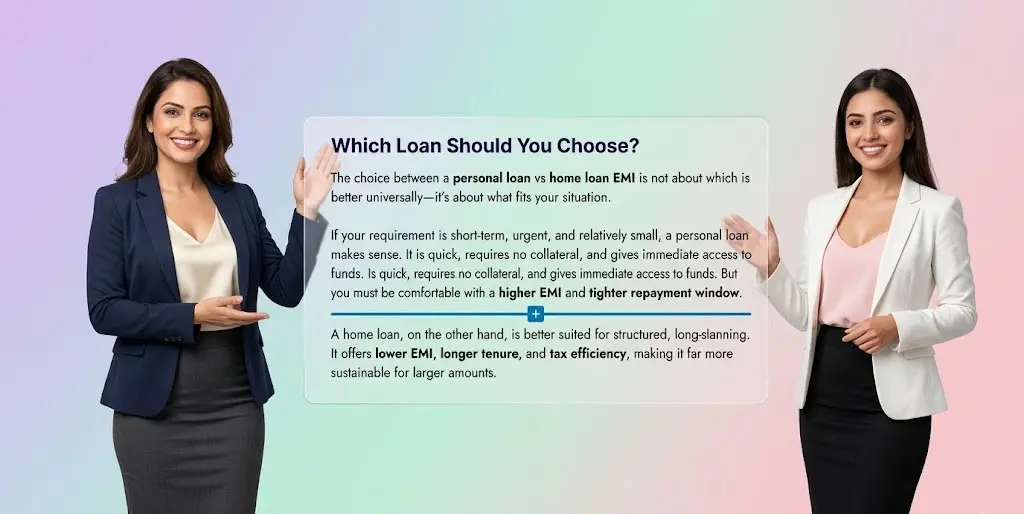
Which Loan Should You Choose?
The choice between a personal loan vs home loan EMI is not about which is better universally—it’s about what fits your situation.
If your requirement is short-term, urgent, and relatively small, a personal loan makes sense. It is quick, requires no collateral, and gives immediate access to funds. But you must be comfortable with a higher EMI and tighter repayment window.
A home loan, on the other hand, is better suited for structured, long-term planning. It offers lower EMI, longer tenure, and tax efficiency, making it far more sustainable for larger amounts.
A simple way to think about it:
- Need speed and flexibility → Personal Loan
- Need stability and lower EMI → Home Loan
Before finalising, it’s worth comparing both side by side:
🔗 Use Personal Loan Calculator to check short-term EMI
🔗 Use Home Loan Calculator to evaluate long-term affordability
Common Mistakes Borrowers Make
Most mistakes in choosing between a personal loan vs home loan EMI don’t come from lack of information—they come from looking at the wrong metric.
The most common error is focusing only on EMI. A lower EMI feels comfortable, but it often hides a longer tenure and higher total interest. On the other hand, a higher EMI may look stressful, but could mean faster debt closure.
Another mistake is ignoring affordability. Borrowers assume they can “manage somehow,” especially with personal loans. But a high EMI can quietly strain monthly cash flow, leaving little room for savings or emergencies.
There’s also a tendency to skip comparison altogether. Many people take the first loan offer they receive, without checking how the EMI of a personal loan vs home loan would differ under similar conditions.
A better approach is simple—pause, compare, and calculate before committing:
🔗 Check Personal Loan EMI vs Home Loan EMI using our calculators

Final Verdict – What Actually Matters
If you step back, the debate around personal loan vs home loan EMI is not about which loan is cheaper—it’s about how you want to manage your financial obligations over time.
A personal loan offers speed and simplicity, but demands discipline. The EMI is higher, the tenure is shorter, and there’s little margin for error. It works well when the requirement is immediate and manageable.
A home loan, in contrast, is built for long-term stability. Lower EMIs, extended tenure, and tax benefits make it easier to sustain, especially for larger financial commitments.
The right choice depends on your cash flow, risk tolerance, and purpose of borrowing—not just the EMI number you see on paper.
Before you decide, take a moment to validate your assumptions:
🔗 Use Personal Loan Calculator for short-term view
🔗 Use Home Loan Calculator for long-term planning
Frequently Asked Questions (FAQs)
Which has lower EMI: personal loan or home loan?
In most cases, a home loan EMI is lower than a personal loan EMI. This is because home loans offer lower interest rates and longer repayment tenures, which spread the cost over time.
Is a personal loan better than a home loan?
A personal loan is better for short-term, urgent needs where speed matters. However, for larger amounts and long-term planning, a home loan is usually more efficient due to lower EMI and tax benefits.
Why is personal loan EMI higher than home loan EMI?
The EMI of a personal loan vs home loan differs mainly because:
Personal loans are unsecured (higher risk → higher interest)
Shorter tenure increases monthly repayment pressureCan I reduce my home loan EMI?
Yes, you can reduce your EMI by:
Increasing tenure
Refinancing at lower interest
Making partial prepaymentsShould I compare EMI before taking a loan?
Absolutely. Comparing personal loan vs home loan EMI helps you understand affordability and avoid over-commitment.
👉 Always check before applying:
🔗 Use Loan EMI Calculator to compare scenarios instantlyWhat is the difference between personal loan and home loan EMI?
The main difference between personal loan vs home loan EMI is that personal loans have higher EMIs due to higher interest rates and shorter tenure, while home loans offer lower EMIs because of lower rates and longer repayment periods.

Related Tools (Must Use Before Taking a Loan)
These tools will help you make a data-backed decision instead of guesswork:
- 🔗 Personal Loan EMI Calculator
→ Best for short-term loans, quick EMI check - 🔗 Home Loan EMI Calculator
→ Ideal for long-term planning with tax impact - 🔗 Loan EMI Calculator (All-in-One Tool)
→ Compare multiple loan scenarios side by side
👉 Pro Tip:
Use both personal and home loan calculators together to clearly see the EMI difference and total cost impact.
Related Articles (Improve Your Decision Further)
Based on your current article layout (screenshot), these are perfect internal links:
Disclaimer: This content is for informational purposes only and does not constitute financial advice. Please assess your financial situation or consult a qualified advisor before taking any loan decision.