
Lumpsum Investment Calculator: Unlock the Power of Compounding
Ready to see how a single, one-time investment can multiply your wealth over the long term? Our Lumpsum Investment Calculator is the essential tool for every serious investor, providing a clear forecast of your portfolio’s Future Value of Investment based on the potent effect of Compounding Power. Input your principal amount, expected return rate, and time horizon to instantly visualize your potential wealth creation.
Want more tools, please explore our tools directory overview and free tools page categories.
Understanding Lumpsum Investing and Compounding Power
A lumpsum investment is a single, large amount of money invested at one time, rather than in periodic installments (like a Systematic Investment Plan or SIP). This strategy is often preferred when an investor receives a bonus, matures a fixed deposit, or inherits a sum of money and wants to maximize its growth potential immediately.
The true magic of this strategy, however, lies in the Compounding Power. Compounding is the process where the returns you earn are reinvested to generate their own returns. The longer the money stays invested, the more aggressively your wealth grows, as the growth accelerates exponentially.
This is why the Lumpsum Investment Calculator is so crucial. It models this exponential growth precisely, moving beyond simple interest to show you the remarkable future corpus you can build by letting time and returns work for you.
Why Calculate the Future Value of Investment?
Determining the Future Value of Investment is the foundation of realistic financial planning. Without this calculation, you are merely guessing your retirement corpus or your child’s education fund.
1. Goal Setting Accuracy
Every major life goal—buying a house, funding a wedding, or achieving financial independence—has a target amount and a time frame. By using a reliable Mutual Fund Calculator (which is essentially what our tool is, given mutual funds are a common destination for lumpsum investments), you can accurately map your current savings to your future needs. Knowing that your ₹5 Lakh investment could turn into ₹20 Lakh in 15 years empowers you to set achievable goals.
2. Rate of Return Analysis
The calculator allows you to experiment with different expected return rates. This is invaluable for comparing different asset classes. You can quickly see the difference between a safe 7% return (like an FD) and a potentially higher 12% return (like an equity mutual fund). The vast difference in the final corpus highlights the importance of choosing the right investment avenue to maximize your Future Value of Investment.
3. Avoiding Inflation Missteps
While you have a separate inflation calculator, this tool works hand-in-hand with it. Once you know the future value of your goal (from the inflation calculator), you can use the Lumpsum Investment Calculator to determine exactly how much you need to invest today to hit that inflated target in the future.
Key Factors in Your Lumpsum Calculation
Our Lumpsum Investment Calculator considers three primary factors, each playing a unique role in your financial outcome:
- Principal (Initial Investment): The higher the principal, the greater the base for compounding. This factor provides the immediate jumpstart to your growth journey.
- Rate of Return (R): This is the engine of compounding. Even small differences in the expected annual return rate can lead to massive differences in the final corpus over decades.
- Time Period (N): Time is the single most powerful ally for a lumpsum investment. Thanks to Compounding Power, the last five years of a 20-year investment period often generate more returns than the first ten years combined. This calculator vividly illustrates this time advantage.
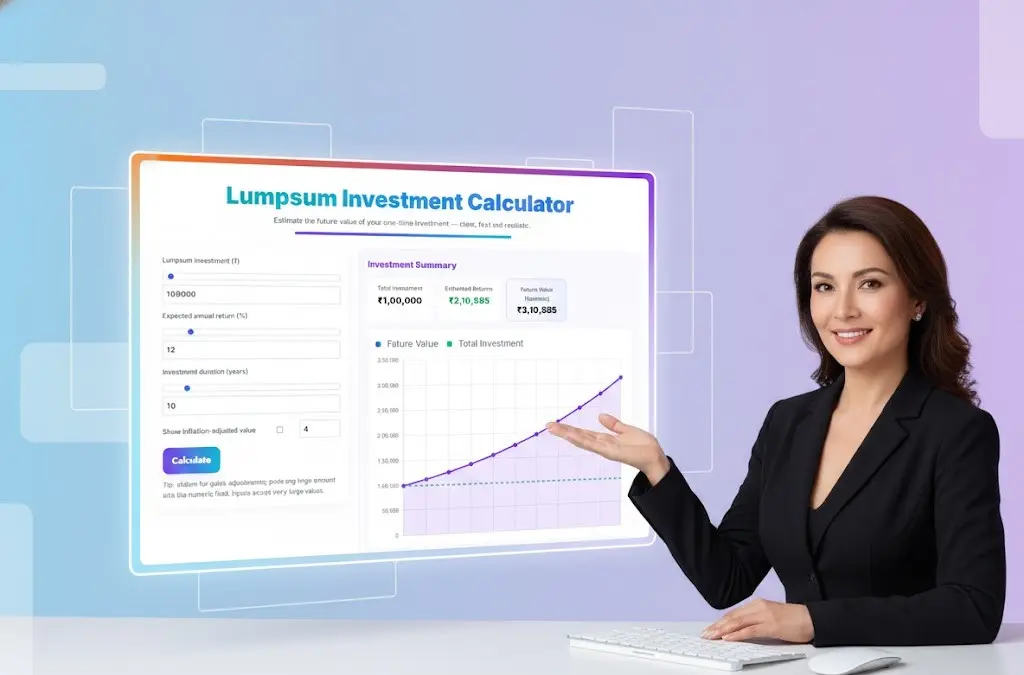
Using the tool is simple: enter your data, click ‘Calculate,’ and review the results. The chart visually separates the total invested amount (your initial principal) from the total estimated returns, giving you a clear, quantitative measure of your wealth growth over every year of your investment horizon. Start planning with precision today!
Frequently Asked Questions (FAQ)
What is the formula used by the Lumpsum Investment Calculator?
The calculator uses the Future Value (FV) formula for compounding: $\text{FV} = \text{P} \times (1 + r)^n$, where $\text{P}$ is the principal Lumpsum Investment, $r$ is the annual rate of return (as a decimal), and $n$ is the number of years.
How does Compounding Power work in Lumpsum investing?
Compounding Power means your returns are added back to your principal investment, and in the next period, the entire new, larger sum earns returns. This snowball effect causes the growth rate to accelerate over time, especially over periods longer than 10 years.
Is Lumpsum investing better than SIP?
Neither is inherently better; they serve different purposes. A Lumpsum Investment is ideal for immediate, available funds, capitalizing on market lows and maximizing the time factor for the Future Value of Investment. SIPs are better for regular savings, utilizing rupee cost averaging to manage market volatility.
What is the average expected return rate I should use for a Mutual Fund Calculator?
For conservative debt mutual funds, 6% to 8% might be suitable. For equity-oriented funds, historical averages often suggest using 12% to 15% for long-term calculations (10+ years), but remember that this rate is an estimate, and actual returns can vary widely.
Related Tools and Directory
- Income Tax Calculator
- Tools Directory Overview
- Free Online tools Hub
- Finance & Tax Tools Hub
- Advance Tax Interest Calculator
- GST Calculator
- HRA Exemption Calculator
- TDS Deduction Estimator — Salary (Monthly Estimate)
- Income Tax Slab Comparison
- Gratuity Calculator
- EPF Contribution Calculator
- Simple EMI Calculator
- Advance Term Loan EMI Calculator
- Car Loan EMI Calculator
- Personal Loan EMI Calculator
- Home Loan EMi Calculator
- SIP Calculator
- SIP Goal Calculator
- Explore more tools for Finance & Tax and SEO on TaxBizmantra.com & CAMSROY.COM